Showing posts with label literary terms. Show all posts

Saturday, February 9, 2019

Dramatic monologue

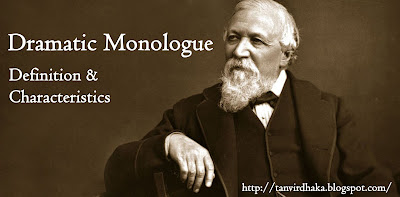
Dramatic monologue is a lyric poem wherein a single character speaks, often in a specific situation, either directly to the reader or to a listener. Such poem is dramatic since it features theatrical qualities. However, a dramatic monologue is different from a drama in many ways. Firstly, in a drama, characters develop through outward action and conflict, whereas in a dramatic monologue, the development occurs through the clash of motives within the speaker. Secondly, unlike a drama the character’s speech is delivered in monologue rather than dialogue since a single speaker speaks alone while the listener remains silent. However, a monologue should not be confused with a soliloquy. The former is different from the latter in the sense that in a monologue the speaker reveals his thoughts and feelings to the reader, or to any other character; whereas in a soliloquy, the speaker expresses his thoughts to himself.
The salient features of a dramatic monologue are as under:
  • The poem begins abruptly to catch the reader’s attention.
  • A single speaker talks to a silent listener.
  • The speaker is not the poet himself rather a persona created by the poet.
  • Psychological analysis and clues to suggest the reader about the mode and temperament of the silent listener.
  • The presence of the listener is ascertained only through the poet’s words.
Although this form is very old, the English poet Robert Browning contributed much to improve it. In fact, most of the outstanding instances of dramatic monologues are penned by Browning. Some of his best dramatic monologues include: My Last Duchess, The Bishop Orders His Tomb, Andrea del Sarto, Men and Women, Christmas Eve and Easter Day, Fra Lippo Lippi, Porphyria's Lover, and Dramatis Personae. Other examples include: Eliot’s The Love Song of J. Alfred Prufrock, Tennyson’s Ulysses, Edgar Allan Poe's The Raven, and Sylvia Plath's Daddy.

Dramatic monologue

Wednesday, January 2, 2019

The Code Hero

The code hero is associated with Earnest Hemingway’s novels. Professor Paul Totah maintains that Hemingway defined the code hero as “a man who lives correctly, following the ideals of honor, courage and endurance in world that is sometimes chaotic, often stressful, and always painful.” Again, Phillip Young considers the code hero as an individual who “offers up and exemplify certain principles of honour and courage which, in a life of tension and pain, make a man a man and distinguish him from the people who follow random impulses [...] and are [...] perhaps cowardly, and without inviolable rules for how to live holding tight.”

The Code Hero

The concept of the code hero heavily stemmed from the post-World War I disillusionment. The code hero generally adheres to some specific individualistic code or behaviour that significantly controls his decisions and conduct. Such hero has a recurrent presence in Hemingway’s novels. Some of Hemingway’s most memorable code heroes include: Frederick Henry of A Farewell to Arms, Jake Barnes of The Sun Also Rises, Robert Jordan of For Whom the Bell Tolls, and Santiago of The Old Man and the Sea.

The term “Code Hero” was coined by the scholar Phillip Young (1966). Some other terms for defining Hemingway’s heroes include the “Hemingway Code Hero”, and the “Hemingway Man”. But regardless of dissimilar names all of Hemingway’s protagonists display the same characteristics:
  • The code hero is courageous and honorable.
  • He is righteous and will not comply with evil.
  • He is essentially individualistic and free willed.
  • The code hero is adventurous and has a predilection for travelling.
  • He neither shows emotions nor does he give any commitment to women or social convention lest he becomes weak.
  • The role of the code hero is always played by a man.
  • He is generally a wounded man, not only physically but also psychologically.
  • He is a man of action and never boasts his achievements.
  • He does not judge others since he views men objectively.
  • He strives hard to break away from the customs of the conventional society, thereby alienating himself from the world.
  • He suffers from sleeplessness due to being tormented by his thoughts and ruminations.
  • He believes that life is enjoyable and it denotes everything while death is nothing (nada) and thus life after death is nonexistent.
  • Death frightens him since it is the end of everything and thus he tries his utmost to avoid death at any cost.
  • Night is a difficult time for the code hero because it implies to utter darkness which ultimately reminds him of death. Therefore, most code heroes are either afraid of the dark or avoid night by drinking, partying, or staying awake.
  • Although he fights hard in this violent and desolate world to live properly, he is rarely the winner.
  • The code hero catches many women’s attention and he sees them nothing but objects of lust and gratification.