Showing posts with label DRAMA. Show all posts

Tuesday, February 25, 2020

Themes of tess of D uberville


Themes of tess of  D uberville

TO JOIN OUR ONLINE ACADEMY

VISIT THE LINKS BELOW


 Tessof the D'Urbervilles -Thomashardy
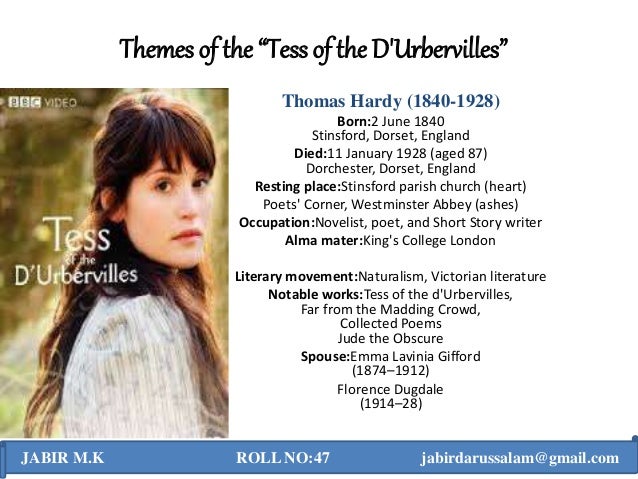
2. Themes of the “Tess of the D'Urbervilles” Thomas Hardy (1840-1928) Born:2 June 1840 Stinsford, Dorset, England Died:11 January 1928 (aged 87) Dorchester, Dorset, England Resting place:Stinsford parish church (heart) Poets' Corner, Westminster Abbey (ashes) Occupation:Novelist, poet, and Short Story writer Alma mater:King's College London Literary movement:Naturalism, Victorian literature Notable works:Tess of the d'Urbervilles, Far from the Madding Crowd, Collected Poems Jude the Obscure Spouse:Emma Lavinia Gifford (1874–1912) Florence Dugdale (1914–28) JABIR M.K ROLL NO:47 jabirdarussalam@gmail.com
3. THEMES • FATE AND FREEWILL: The cruel hand of fate hangs over all the characters and actions of the novel, as Tess Durbeyfield's story is basically defined by the bad things that happen to her. Hardy presents a world in which circumstances beyond the control of Tess determine her destiny. Luck, chance, coincidence, and environmental forces continually work against Tess to entangle her in one casualty after another. Her social status, her accident with the horse, her row with Car Darch, the forest encounter with Alec and the resulting pregnancy, the death of her father, the eviction of her family, and so on all weave her into a web from which there is no escape. The narrator calls attention to this theme in Chapter 11 after Alec rapes–or seduces–Tess. JABIR M.K ROLL NO:47 jabirdarussalam@gmail.com
4. THEMES • MALE PREDOMINANCE AND SEXUAL HARASSMENT In the 19th Century, males dominated society and expected females to do their order. Tess’s resistance to the advances of Alec succeed for a time, but he eventually entraps her after continually harassing her. Although Angel loves Tess and marries her, he abandons her shortly after their wedding when he discovers what happened between her and Alec. It does not matter to him that he himself had an affair before he was married. Men may stray with impunity, he believes. Women may not. After Tess’s father, John Durbeyfield dies, his wife and children are evicted. It was he who was privileged to hold the lease to their property, not his wife. JABIR M.K ROLL NO:47 jabirdarussalam@gmail.com
5. THEMES • MODERNISM: Shortly after Tess becomes a mother she leaves her home to labor in the fields as part of the villager community that must bring in the communal grain for the winter. In the middle of this golden bucolic scene, Hardy places a bright red reaping- machine. These mechanic intruders enable the field workers to get much more work done in a shorter period of time. The work is done quickly, the workers must travel about from farm to farm trying to eke out a living, and onward then in time to cities like London and Manchester to work in factories as cogs in the machines of the Industrial Revolution. Hardy called this the “ache of modernism,” which separated man from Nature. JABIR M.K ROLL NO:47 jabirdarussalam@gmail.com
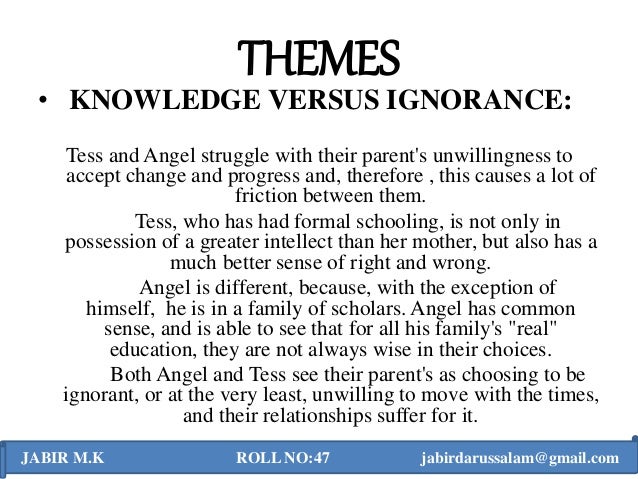
6. THEMES • KNOWLEDGE VERSUS IGNORANCE: Tess and Angel struggle with their parent's unwillingness to accept change and progress and, therefore , this causes a lot of friction between them. Tess, who has had formal schooling, is not only in possession of a greater intellect than her mother, but also has a much better sense of right and wrong. Angel is different, because, with the exception of himself, he is in a family of scholars. Angel has common sense, and is able to see that for all his family's "real" education, they are not always wise in their choices. Both Angel and Tess see their parent's as choosing to be ignorant, or at the very least, unwilling to move with the times, and their relationships suffer for it. JABIR M.K ROLL NO:47 jabirdarussalam@gmail.com
7. THEMES • PREJUDICE: This theme manifests itself in Chapter 2 when Angel Clare asks his brothers to attend the country May dance with him. Felix replies, “Dancing in public with a troop of country hoydens– suppose we should be seen!” In Chapter 40, Mercy Chant exhibits an anti-Catholic bias after she hears that Angel is going abroad. JABIR M.K ROLL NO:47 jabirdarussalam@gmail.com
8. THEMES • THE LURE OF MONEY: In the novel, Alec d'Urberville uses money to attempt to win Tess. He succeeds. Here is the scenario: After John Durbeyfield dies and his family is evicted, Alec offers to house the Durbeyfields if Tess will yield to him. Tess–ever concerned about the welfare of her family–accepts his proposition.

Monday, August 21, 2017

The Use of Names in Ben Jonson's Plays

The astute choice of a character’s name is something we, as readers, cherish in literature. We only have to recall Dickens’s villains to see how important a name can be in the depiction of a certain personality – the name Ebenezer Scrooge (A Christmas Carol), for example, with its harsh consonants, immediately hints at unkindness and cruelty, whilst the name Verneering (Our Mutual Friend) at once reveals a sense of superficiality and an obsession with ostentation. When dwelling on the importance of names in literature, we may also recall Virginia Woolf’s feminist novel A Room of One’s Own, the heroine of which is never fully identified apart from as ‘Mary’. Given that this name was, at the time, the most common female name, this naming sets her forth as a universal figure of feminine life. This tradition of the precise selecting of names partly stems back to Medieval morality plays, in which the characters each represent a particular virtue or vice and are named accordingly: in the anonymously-written, archetypal morality play, Everyman, the protagonist is surrounded by characters like ‘Good-Deeds’, ‘Beauty’, ‘Knowledge’ and ‘Strength’. Arguably, it was this tradition that Ben Jonson drew on in the skilled naming of his characters: though their names can be easily overlooked, his specific choices often emphasise particular aspects of his satirical writing. In his three most famous comedies, Volpone, The Alchemist, and Bartholomew Fair, Jonson uses names to exemplify the idiosyncrasies of his characters before we have even met them, and it is often the naming of his characters that drives his satire or elucidates his plots.

The naming of characters in Volpone is the simplest manifestation of this phenomenon. In the play, Jonson draws directly on the medieval fabliaux tradition and, as Michael Jamieson points out, ‘The people of the play are, through their names, invested with animal symbolism…’ The play is set in Venice, a city which was, to the Elizabethans, seen as a hub of corruption – many audience members would recall the usury of Shylock in Shakespeare’s Merchant of Venice. The name Volpone, in Italian, literally means ‘sly fox’, and thus the protagonist comes to represent this corruption – his manipulative scheming (evident in his comic asides), like that of Subtle, Face, and Doll in The Alchemist, comes straight out of the cony-catching pamphlets of the Early Modern period. The other characters are likewise elucidated by their names: Corbaccio (‘the raven’), Voltore (‘the vulture’) and Corvino (‘the crow’) are all carrion-eating fowl, hungry not for flesh but for the wealth of the play’s protagonist. This animalism is so extreme that Corvino, for instance, commits to disinheriting his son and prostituting his wife. But this is Jonson’s name choosing at its most simple. More interesting are characters like Sir Politic Would-Be, whose name gives away his role as the ridiculous Englishman abroad, vainly attempting to be politic and sensible, an endeavour in which he fails miserably. Indeed, he is so absurd that he notes in his diary every single action he performs (including urination) during each day, and he characteristically ends the play hiding in a tortoise shell, the victim of one of Peregrine’s clever pranks. Thus, we can see how his name goes towards a satire of the ignorant English traveller, his mind filled with extravagant and bizarre business ideas with which he bores characters and audience alike. Likewise, the name ‘Littlewit’ is ironically telling, making the opening scene of Bartholomew Fair all the more humorous. This garrulous amateur dramatist is infatuated with his own negligible intelligence, constantly endeavouring to present himself as a witty and clever orator. For example, when Winwife employs some relatively clichéd metaphors (‘strawberry-breath, cherry-lips, apricot-cheeks, and a soft velvet head’), Littlewit ironically cannot restrain his admiration: ‘that I had not that before him, that I should not light on’t as well as he! Velvet head!’ Justice Overdo’s name is similarly revealing of his character, predicting the exaggeration and self-satisfied nature of his speeches: ‘Now to my enormities: look upon me, O London! and see me, O Smithfield! The example of justice, and mirror of magistrates, the true top of formality, and scourge of enormity. Hearken unto my labours…!’ He, along with the Puritan Rabbi Zeal-of-the-Land Busy, is just one of the many bourgeois characters of this carnivalesque play whose pretensions to honour, authority and religiosity are mocked by Jonson (who, of course, loathed the Puritans for their critique of the theatre), and it is the naming of these characters that contributes to Jonson’s mockery.

Similar naming techniques are used in one of Jonson’s other satirical comedies, The Alchemist. Sir Epicure Mammon is one of the ‘gulls’ hoping to get rich from Subtle’s feigned magical skill. The name Epicure refers to the Ancient Greek philosopher Epicurus, famed for an emphasis on sensual pleasure (though this depiction of his philosophy is somewhat inaccurate and exaggerated). The name Mammon is also suggestive, meaning ‘wealth regarded as an evil influence or false object of worship or devotion’. To an extent, then, the name Epicure Mammon is oxymoronic – though his forename implies an emphasis on material and physical existence, his surname seems to refute that, again showing how Jonson uses names to mock certain characters. So it’s no wonder that a character with such a name is so obsessed with the wealth and material riches that he hopes to acquire, which he boasts about to Doll: he shall have ‘glasses / Cut in more subtle angles, to disperse / And multiply the figures, as I walk / Naked between my succubæ.’
Even more witty a choice of name is the name adopted by Jeremy the Butler, who refers to himself as Captain Face whilst he is operating as a member of London’s criminal underworld. The name alone suggests the adoption of a mask, though we don’t find out until Act V that his real name is Jeremy. As Jonathan Haynes points out, ‘All traces of origin are effaced’ by Face’s ‘constant and impeccable role-playing.’ Thus, Face is an ‘impostor’, one of many corrupt characters lurking in London’s underworld: as the Prologue explains, ‘No clime breeds better matter, for your whore, / Bawd, squire, impostor, many persons more.’ (lines 7-8) At the end of the play, though, Face is unmasked. And yet, he is, to some extent, the victor of the play. He is so manipulative and skilful that Lovewit’s neighbours think ‘Jeremie / Is a very honest fellow…’ Moreover, as the name Lovewit would imply, Face’s master appreciates his wit and scheming intellect, and thus Face can use his wit to gain his master’s pardon:

‘Give me but leave to make the best of my fortune,
And only pardon me thi' abuse of your house:
It's all I beg. I'll help you to a widow,
In recompense, that you shall give me thanks for…’

Hence, at the end of the play, Lovewit pays tribute to his servant’s ingenuity: he is ‘very grateful’ to have ‘received such happiness by a servant.’ It’s no surprise that a character called Lovewit would feel obliged to be ‘A little indulgent to that servant’s wit,’ and thus again we can see how Jonson’s use of naming helps not only to illustrate his characters, but to develop and almost foreshadow the plot. And though Lovewit is the eventual winner of the play (gaining a wife and augmented wealth), Face certainly ends up better off than his two scheming companions Subtle and Doll, who are forced to flee once the master of the house arrives unexpectedly. Face is what was known in the Renaissance period as a ‘taker-up’:

‘The taker-up seemeth a skilful man in all things, who hath by long travail learned without book a thousand policies to insinuate himself into a man’s acquaintance. Talk of matters in law, he hath plenty of cases at his fingers’ ends, and he hath seen, and tried, and ruled in the King’s courts. Speak of grazing and husbandry, no more knowether more shires than he, nor better way to raise a gainful commodity, and how the abuses and overture of prices might be redressed.’ – Greene, Notable Discovery

Face can use his wit to adopt multiple different personalities (hence the name ‘Face’, establishing his use of masks) – as Haynes explains, ‘Everyone is spoken to in his own language.’ He can talk to Drugger about tobacco, he can talk to Dapper about his milieu, all the while ready to transform back into Jeremy the Butler. Thus, the barrier between the criminal underworld and straight society becomes permeable for him, whilst it is not for Subtle and Doll. In this sense, Face can be seen as a warning to Elizabethan theatre-goers, his character demonstrating the Trump-like deceptions and manipulations not only of the criminal underworld, but of society in general.

We must remember, though, how aware Jonson was of the dangers of satire – he was, after all, arrested and imprisoned more than once for his satirical work. One of his most interesting satirical works, Poetaster, works completely differently in terms of naming. Jonson’s play sets out, amongst other things, to revenge the criticism he had received from Marston, Dekker and others during the so-called ‘War of the Theatres’ or Poetomachia. But, as he explains in his Apologetical Dialogue, he aims to ‘spare the persons and to speak the vices’. By setting his play in Augustan Rome rather than in London, Jonson champions his own style of Horatian satire (or, at least, the style of poetry to which he aspires), while criticising the Juvenalian satire of Marston and Dekker (though, in bitterly attacking these two playwrights as ‘vile ibids’ in the Apologetical Dialogue, Jonson was hypocritically sinking to the Juvenalian level) – thus, the play can be seen as a general satire of the poetaster figure whilst also criticising Jonson’s rivals. The loathsome Crispinus is often read as a representation of Marston – towards the end of the play, Crispinus vomits up what Tom Cain refers to as a series of ‘Marstonisms’, a pretentious and bombastic lexical flood including words like ‘retrograde’, ‘incubus’, ‘glibbery’, ‘magnificate’ and more. Moreover, the two poems that Crispinus and Demetrius read are undeniable parodies of Marston and Dekker’s work. But still, by choosing not to name Marston in the play, Jonson arguably escapes accusations of Juvenalian, bitter satire.

By (uncharacteristically) avoiding the use of illuminating names, Jonson is also able to compare himself to the great Augustan poet Horace, ‘a self-projection of Jonson’ according to Tom Cain. After all, the two poets were indeed very similar – Horace was often taunted because his father was a freed slave, and Jonson was acutely self-conscious of his step-father’s profession as a brick-layer; Horace had fought in Philippi, Jonson fought in the Low Countries. To an extent, then, Jonson seems to be modelling himself on Horace: in fact, in his Discoveries Jonson advocated exactly that: the ability ‘to bee able to convert the substance, or Riches of an other Poet, to his owne use.’ Thomas Smith even praised Jonson as ‘the elaborate English Horace,’ and like Horace, Jonson often chose to write in a realist style, ‘out of use and experience’ (Discoveries). Thus, Jonson could implicitly compare himself to the great Augustan satirist in an attempt to elevate his style.

There are other comparisons in Poetaster that also ought not to be ignored. The play opens with Ovid composing a poem which turns out to be one of Marlowe’s own translations of Ovid, lines from a banned edition published with Sir John Davies’s epigrams. Marlowe was one of the most loved poets of the day, and Jonson clearly respected him, though Marlowe does not completely escape criticism – compared to the virtues of Virgil and Horace, Ovid is seen as sensuous and arguably blasphemous in his organisation of the Divine Banquet (this, again, would link the Ovid character to Marlowe, who was often accused of blasphemy and atheism, and whose play Dr Faustus presents us with a similarly blasphemous banquet scene in Rome). So by presenting Ovid in such a way that we can’t help thinking of Marlowe, Jonson was able to express his opinions without fear of danger – Thomas More arguably used a similar technique in Utopia, hiding his own beliefs from the reader. Thus, the banishment of Ovid could be compared to the death of Marlowe, and as Tom Cain writes, ‘The Ovid being rejected is as much the Ovid of the 1590s in England [i.e. Marlowe and poets who wrote in a similar vein] as the historical Ovid of Augustan Rome.’ Finally, by setting the play in Rome, Jonson could make a subtle contrast and criticism between the high regard poets were held in under Augustus’s rule, and their relatively harsh treatment in Elizabethan England. It is poets that guide the Emperor Augustus in Jonson’s play, whilst it was libel and informers (like Tucca) that drove the Essex Rebellion of 1601, the year Jonson’s play was first performed.


So it’s clear that names played a huge role in Ben Jonson’s dramatic work. In his later comedies, he used names to elucidate and expound the personalities of certain characters whilst also satirising or ironizing them, whilst in the earlier Poetaster he deliberately avoids the direct naming of his subjects (if we can go so far as to say for sure that Jonson was attempting to satirise Marston and Dekker, amongst others). It is Histrio’s plays that directly mock and bitterly attack individuals: Ben Jonson, posing as the virtuous Horace, suggests he will not wrong ‘men’s fames’ (Trebatius’s words) in his verse. The implication is that Jonson (as Horace), along with Virgil (whom some critics have claimed resembles Chapman), is aloof from that, though it is doubtful whether he really is. Whatever the answer, it’s clear that Jonson thought very carefully about the choice of names in his plays, and through those names he makes his comedies and satires all the more powerful. As Haynes argues, Jonson used his art ‘in society as a weapon, or tool, or organ.’ Whether it was mocking the folly of naïve bourgeois figures like Cokes or Littlewit; whether it was revealing and revelling in the dark scheming of the criminal underworld; whether it was critiquing Early Modern nascent capitalism; or whether it was responding to the attacks of other poets, Jonson made the naming of characters an expressive tool in his work, carrying on and expanding earlier traditions, and influencing the work of writers who came after him.

Thursday, August 17, 2017

Religion in Marlowe’s 'Jew of Malta'

Whilst Marlowe was writing, anti-Semitism was rife across the entirety of Europe. The Renaissance period saw the rise of increasingly xenophobic, anti-Jewish fears somewhat comparable to the prejudice against Islam in the Western world today, fed on and augmented by President Trump. We only have to look at the work of the so-called Old Masters to see how widespread these anti-Semitic sentiments really were. Not only were Jesus and his followers stripped of their Jewish identity and transformed into anachronistically Christian figures, but also, on the rare occasion that Jews were actually depicted in Renaissance art, their portrayal was far from complimentary. Albrecht Durer’s Jesus Among the Doctors is a case in point: the Jew that stands to the right of Jesus is almost caricature-like with his grotesque grin and hooked nose. Given the pervasiveness of this anti-Semitism, it’s no wonder that Marlowe’s Barabas is likewise presented according to the bigoted values of the age. He is, in fact, a complete caricature of the selfish and cruel Jew. And yet, what’s interesting about Marlowe’s play The Jew of Malta is that Jews are not the only group to receive criticism. Indeed, almost every religious group, Jews, Christians and Muslims alike, seem to be at the receiving end of Marlowe’s reproach. This can be said for the majority of Marlowe’s work, much of which is dedicated to the analysis and condemnation of religious doctrine and hypocrisy. So, with reference to Marlowe’s work and in particular The Jew of Malta, I intend to explore Marlowe’s views on religion as presented through his plays.

I must, of course, begin this essay with an analysis of the loathsome and Machiavellian character of Barabas. The prologue of the play, delivered by Niccolò Machiavelli himself, describes how Barabas ‘smiles to see how full his bags are crammed, / Which money was not got without my means.’ Immediately, then, he is presented as a typical machiavelle figure of Renaissance drama, characterised by the same scheming villainy encapsulated by Iago (Othello) and Edmund (King Lear) in Shakespeare’s plays. The words ‘my means’ refers to the philosophy set out by Machiavelli in his famous work Il Principe – a proto-self-help book preaching expediency over morality and the appearance over the reality of virtue. Barabas fills this role perfectly, almost all of his actions recalling Satan’s words in Book 4 of Milton’s Paradise Lost: ‘Evil be thou my Good.’ For example, he distances himself from the man with a conscience who ‘for his conscience lives in beggary.’ It is by acting without a conscience, Barabas implies, that he has acquired his huge fortune. This lack of conscience links directly to his greed and self-interestedness, obvious in the equal weight he gives to his wealth and to his daughter when he exclaims: ‘O girl! O gold!’ This levelling comparison clearly influenced Shakespeare in The Merchant of Venice when he had Shylock exclaim “O my ducats, O my daughter…” Barabas’s selfishness is also evident in his asides during the conversation he has with the other Jews in Malta. He says: ‘Assure yourselves I’ll look – unto myself.’ He cares only for himself, even bringing about the murder of his daughter’s lover to get his revenge on Ferneze. But, in the words of Harry Levin, these asides also serve to show Barabas’s Machiavellian emphasis on appearance, distinguishing between ‘deeds and words.’ He hides his true intentions from the other Maltese citizens, but treats the audience as his confidantes and thus implicates us in his crimes.

Though we may have some pity for Barabas in his cruel treatment by the Maltese governor and his similarities to Job, our sympathy quickly dissipates as he develops from a simple miser to a murderous villain. As Levin points out, Barabas ‘is a man with a grievance, but his retaliation outruns the provocation.’ Though he may begin as a revenger, he very quickly turns into the villain himself. This murderousness is clear in the famous speech Barabas gives when purchasing Ithamore as a slave: ‘As for myself, I walk abroad o’ nights, / And kill sick people groaning under walls; / Sometimes I go about and poison wells…’ Whether these claims are true is uncertain. It’s possible that this speech is only made in order to entice Ithamore, whom Barabas seems to have already discerned as a villain who, like him, hates Christians. Perhaps, also, Marlowe was simply playing on and parodying the extreme hatred for Jews in Europe. Whatever the answer, it’s undeniable that Barabas fulfils these murderous claims – by the end of the play, he has poisoned and killed the whole of a nunnery (including his own daughter), caused the death of two friends, slaughtered numerous Turkish soldiers, and much more. As the play progresses, his hands grow more bloody and his heart blacker, becoming exactly what European society expected a Jew to be. So it’s clear that Marlowe is playing on these early modern prejudices to present us with the frightful image of a Jew who really only cares for himself and his revenge.

And yet, it’s not just Barabas who is presented as a loathsome figure – almost every character in the play, apart from Abigail, is selfish and unsympathetic. And though we may strongly dislike Barabas, we are watching ‘the tragedy of a Jew’ - Barabas is our tragic hero, and to an extent we see the play from his perspective, often taking his side against the play’s other characters. Our sympathy for Barabas is stirred when he has his wealth seized by Ferneze the governor, under threat of Christian conversion. During this scene, Barabas launches a succession of bitter attacks against Christianity, beginning with the words: ‘Will you then steal my goods? / Is theft the ground of your religion?’ Here, Barabas points out the hypocrisy of their actions, going against the commandment ‘Thou shalt not steal.’ When Ferneze attempts to justify the cruelty of the Christians, he explains that Jews are infidels and that they ‘stand accursèd in the sight of heaven.’ This idea, that the Jews are to blame for the death of Christ (the ‘first curse’) and are therefore born sinful, was a typical trope of the period. Though the audience of the time may also have held this belief, it’s clear that Marlowe did not, or else he would not have allowed Barabas to respond in such cogent terms, appealing as he does to our sense of justice: ‘Shall I be tried by their transgressions? / The man that dealeth righteously shall live…’ Though we know that Barabas is far from righteous, we still sympathise with his argument that men should be judged according to their actions, not according to the actions of their ancestors. This can also be read as a Marlovian argument against the Calvinistic doctrine of Original Sin which held that all humans are born sinful due to Adam’s fall. And so, in this episode it is the Christians who are presented as heartless, with ‘policy’ (trickery or duplicity) as their profession, using scripture to confirm their wrongs. Arguably, it is this unjust and hypocritical treatment that leads Barabas to ‘make bar of no policy’ and adopt the same cruel attitude as the Christians have towards him.

So when Barabas says to his daughter that ‘religion / Hides many mischiefs from suspicion’ we can’t help but agree. The Christians of Malta have used their religion to justify their cruelty against the Jew, even though that cruelty goes against the New Testament credo ‘Love thy neighbour.’ Marlowe also takes care to demonstrate the vices of churchmen themselves, with Friar Jacomo and Friar Bernardine fighting over Barabas’s wealth. They care nothing for the cleansing of his soul or for his conversion – they care only for the goods he promises them. Indeed, Jacomo is so covetous of Barabas’s wealth that he stabs Bernardine, a fellow Christian. So Marlowe, here, is mocking and criticising the greed of the church and their hypocrisy. There are numerous other instances of this throughout the play. For example, when Abigail dies, she asks Friar Bernardine to ‘witness that I die a Christian’ and he simply replies: ‘Ay, and a virgin, too, that grieves me most.’ He breaks Church law when he reveals the contents of Abigail’s dying confession, and hopes to use what she has told him as blackmail. Once this scene has taken place, we can’t help but recall Ithamore’s earlier question: ‘have not the nuns fine sport with the friars now and then?’

It’s clear, then, that Christians and the Church also come under attack in this play. Indeed, the play’s conclusion reinforces Abigail’s beautiful lament that ‘there is no love on earth, / Pity in Jews, nor piety in Turks.’ She’s certainly right that Ithamore (the main representative of the Turks in the play) and Barabas are wicked. Abigail’s mistake, though, is to think there is love, pity, or piety in the Maltese Christians, who reveal themselves to be just as sinful and scheming as Barabas himself. Barabas is only killed at the end of the play because he is out-manoeuvred by another schemer, Ferneze, who, despite his religion, shows no mercifulness whatsoever at the play’s conclusion. As Barabas calls out ‘Help, help me, Christians, help!’ and asks ‘Governor, why stand you all so pitiless?’ Ferneze explains that he has no pity for him at all, wishing to see his ‘treachery repaid.’ Again, this demonstrates his religious hypocrisy – as a Christian, he ought not only to forgive and show mercy, but also to see it as God’s role to ensure justice, not his own. Thus, Ferneze abandons his religious morality (which he seems never really to have had) and uses Barabas’s own tactics against him. We might conclude with Levin, then, that ‘Morally, all of them operate on the same level, and that is precisely what Marlowe is pointing out.’ Every religious group is shown to be vicious and hypocritical, and various Christian doctrines come under attack, notably the idea that ‘Faith is not to be held with heretics,’ which Barabas himself uses against the Christians.

What’s most interesting, though, is that, whilst Marlowe was simply following theatrical clichés and contemporary bigotry when he presented Barabas in such a negative light, such an attack on Christians and Christian doctrine was rarely seen on stage. Perhaps this goes some way to reveal Marlowe’s own religious views. Indeed, as Paul H. Kocher suggests, Marlowe was ‘one of the most highly subjective playwrights of his age.’ Thus, the outright criticism of Christianity in The Jew of Malta may be suggestive. Moreover, Christianity is repeatedly questioned in Marlowe’s other works, notably Dr Faustus. Though the play is set within an undoubtedly Christian framework, and though Faustus is inevitably damned for his transgressions, we cannot help sympathising and even admiring his revolt against religion. We too desire to know the answer to eschatological questions like ‘who made the world’ and we too appreciate human beauty. Thus, the beautiful speeches Faustus gives cannot help inspiring our approbation. Indeed, Faustus’s paean to Helen (‘Was this the face that launch’d a thousand ships / And burnt the topless towers of Ilium?’) is one of Marlowe’s most powerful speeches, urging us to appreciate the strength of Faustus’s emotions when he tells the spirit: ‘thou art fairer than the evening’s air.’ W.W Greg argues that, sharing Faustus’s aesthetic appreciation, we allow ourselves to sympathise with him. Moreover, the fact that Marlowe’s verse reaches its pinnacle during a description of Helen, a symbol of pagan Greece, is surely indicative of his own feelings.

We don’t have to look far to find proof of these doubtful feelings in Marlowe’s biography. As Kocher pointed out, criticism of religion (and Christianity specifically) seems to have been ‘the most absorbing interest of his life.’ The first hint that Marlowe may have had an aversion to Christianity came when, having studied at Cambridge under an Archbishop Parker scholarship, Marlowe did not take holy orders as expected. More convincing are the allegations of atheism that Marlowe received a few years after his death: Baines, Aldrich, Cholmley and others all accused Marlowe of similar crimes, largely revolving around the preaching of atheism and the jesting at religious scripture and doctrine. Marlowe, like Machiavelli of the prologue, seems to have seen religion as no more than a ‘childish toy’.

Hence, when Faustus says that ‘hell’s a fable’ we cannot help recall Baines’s statement that Marlowe ‘perswades men to Atheism willing them not to be afeard of bugbeares and hobgoblins.’ And when Tamburlaine briefly comments ‘The God that sits in heaven, if any god,’ (my italics) it’s hard not to attribute this doubt to Marlowe himself. After all, given that Marlowe never intended to write two parts to Tamburlaine’s story, it’s odd that Tamburlaine is not punished for his crimes and his blasphemous aspirations in Part 1, and it’s doubtful whether his death in Part 2 can be seen as retributive justice rather than the natural result of mortality. Despite killing thousands of innocents, no god punishes Tamburlaine, suggesting Marlowe’s doubts as to whether there is any god at all. Moreover, when Barabas jests at Christian doctrine and blasphemes against Christ (for example, by marking his hidden jewels with a cross), it cannot escape our notice that Marlowe probably made similar jests and blasphemous remarks during his own lifetime, and thus that Marlowe is, to some extent, talking through Barabas. I hope, then, that I have shown how Marlowe’s own doubts and possible atheism are demonstrated in his work. Given the corruption of the Catholic Church in the Early Modern period (Anthony Kenny described Pope Alexander VI as ‘the most villainous man ever to have occupied the Roman See’), and given the oppressive nature of the Calvinist doctrine of predestination, it’s no wonder that an intellectual like Marlowe had difficulties in accepting Christianity. Like the characters he created, he struggled to see past the hypocrisy of churchmen, the contradictions in religious doctrine, and the restraints that Christianity (or indeed any religion) placed on its followers. 

Sunday, August 13, 2017

The Conflict of Idealism and Realism in The Parnassus Plays

Though we often think of modernism as the point at which artistic creation and the role of the artist-poet in society really became a major consideration of artistic work (exemplified by Wallace Stevens’s ‘Of Modern Poetry’), it was, in fact, during the Renaissance that this trend was first developed. Rogier van der Weyden’s Saint Luke Drawing the Virgin (right, c. 1445-50) is a perfect example of this motif, with van der Weyden’s painting bringing to the fore the idea of artistic creativity. The same can be said of Vermeer’s The Art of Painting (below left, 1666), a self-portrait of Vermeer painting an allegorical figure, possibly the Muse of History. As Walter Liedtke suggested, the painting can be read ‘as a virtuoso display of the artist's power of invention and execution…’ We can also see this focus on artistic creation as a theme in the poetry of the Elizabethan sonneteers, with Astrophel and Stella’s opening sonnet considering the difficulties of writing innovative verse. Still, the main focus of the sequence is not art itself – though it contemplates the ideas of artistic creation and convention, the sequence is mainly concentrated on love and desire. The Parnassus Plays, alongside the plays of the Poetomachia, were the first set of plays wholly devoted to the idea of writing as their central subject. As Paula Glatzer argues, the trilogy is ‘an Elizabethan embodiment of the eternal conflict between an artist and his society.’ But whilst the aforementioned paintings emphasise the dignity and importance of the artist in society, The Parnassus Plays, written at the turn of the century by Johnian students, focus more on the difficulties faced by scholar-poets. The trilogy moves from an almost naïve idealization of the accumulation of knowledge, to a highly pessimistic depiction of a cruel society, with the final two plays dominated by harsh realism and stinging satire. It is this progression from idealism to realism that holds the trilogy together and makes it such a relevant text to both students and artists today.

The first play is by far the most idealistic of the three. It begins with Consiliodorus counselling Philomusus and Studioso before they set out on their voyage to Parnassus, an allegory for embarking on their university studies. Consiliodorus speaks from ‘experience’ when he urges them on their voyage, lucidly depicting an idealised vision of Parnassus: ‘Where with sweet Nectar you youre vaines may fill, / … And teache them write some sweeter poetrie…’ Consiliodorus explains that, if he were young, he would make the voyage, even though he ‘foreknewe that gold runns to the boore’ – as he says, he would ‘be a scholler though I liue but poore.’ This is the central theme of the entire trilogy – that intellect will not bring worldly goods, and that scholars are largely condemned to poverty (‘Learninge and pouertie will euer kiss’). This is indeed a realist depiction of the scholar-poet’s struggle, and yet, for Consiliodorus, this is no reason for abandoning the scholarly life – rather, the problem is with society itself, ‘That knoweth not howe to weigh youre worthiness.’ As Glatzer argues, ‘if artistic values are superior, then society and its material rewards are things that the true Parnassian must transcend.’ Consiliodorus urges the scholars to go to ‘that pure and happie springe’ and then ‘Returne triumphant with youre laurel boughes…’

These are indeed glorified visions of learning and poetry, visions that will later be challenged by the failed scholar-poets and poetasters encountered during the voyage, the very ‘lozell, lazie, loitering gromes, / All foggie sleepers, and all idle lumps’ that Consiliodorus warned them against. The first tempter they encounter is Madido (‘moist one’), a drunkard who has abandoned his voyage in the land of logic in favour of wine and the poetry he believes that alcohol can inspire. Though Madido is a comic character and an antagonist, we are charmed by his effective use of simple diction set in rhythmic prose. We must also remember that this was first performed for students, who must have experienced similar temptations. And when Madido complains of patrons with ‘asses ears’ and claims that ‘This Parnassus and Hellicon are but the fables of the poetes,’ we cannot help but agree. Still, Philomusus and Studioso remain steadfast in their resolution, rejecting alcohol for ‘learnings glorious meede’. The second character they meet is Stupido, a much less persuasive character. Whilst Studioso says that he ‘neuer sawe a more delicious earth… Then here is in this lande of Rhetorique,’ the puritan Stupido condemns ‘these vaine artes of Rhetorique, Poetrie, and Philosophie.’ Stupido is an archetypal version of the satirized puritan figure, pompous, repetitious, arrogant, and generally ignorant. For example, the only argument he has for art’s immorality is the outlandish clothing of poets: ‘Artistes [are] fools, and that you may know by there vndecent apparell.’ This exchange, then, partially links to Sidney’s Defence of Poesy in that the author of The Pilgrimage is defending poetry against puritanical accusations of immorality. The real reason for Stupido’s puritanical rage, Philomusus reveals, is not his morals, but that fact that ‘he cannot reach vnto the artes’ and thus ‘Makes showe as though he would neglect’ them.

The next two failed scholar-poets that the protagonists encounter are Amoretto and Ingenioso, met in the land of poetry and the land of philosophy respectively. Amoretto enters reading verses from Ovid and seems to personify the argument against poetry that Sidney referred to when he described ‘how much it abuseth men’s wit, training it to wanton sinfulness and lustful love…’ Amoretto has made the error of believing that love and lust are the only subjects for real poetry – it is in poetry, Amoretto says, that they shall ‘all youre hungrie sences feaste…’ The two scholar-poets are tempted by Amoretto, who eloquently tempts them towards ‘wantome merriments’. These temptations are so strong that Philomusus speeches tend towards the more sensuous rhetoric of Amoretto, particularly when he says: ‘Phoebus hath laid his golden tressed locks / In the moist cabinet of Thetis lapp.’ And yet, with the opening of Act V, the two seem unsatisfied with these ‘yonge maides’, as Studioso says: ‘Howe sourelie sweete is melting venerie: / It yealdeth honie, but it straighte doth stinge.’ This leads Studioso to abandon the realm of poetry altogether, and this is precisely what Sidney warns against in his Defence – the danger of rejecting all poetry simply because of a few ‘entisinge Panders, subtile baudes’. But Philomusus refutes Studioso’s argument, picking up on the Sidneian rationale that ‘who reades poets with a chaster minde / Shall nere infected be by poesie.’ Like Sidney, the playwright suggests the greatest threat to poetry comes from those who abuse it from within.

The two protagonists’ final encounter is with Ingenioso, who agrees with Consiliodorus that ‘Learninge and pouertie will euer kiss’. And yet, whilst Consiliodorus saw this as a matter of Stoic acceptance, valuing learning above material wealth, Ingenioso lures Philomusus and Studioso from their path because ‘Parnassus is out of siluer…’ This final act prepares us for the succeeding two plays, with Ingenioso describing how ‘Apollo is banckroute’ whilst ‘tapsters, ostlers, carters, and cobblers haue a fominge pauch.’ But the protagonists reject Ingenioso’s complaints, declaring that, though they ‘knowe that scholers comonlie be poore / And that the dull worlde there good partes neglecte,’ they still ‘thinke not worse of faire Parnassus hill’. This stoic acceptance and idealised conception of intellectual value is admirable, but Ingenioso’s final words are nonetheless prophetic: ‘Farewell, and take heede I take youe not napping twentie yeares henc in a vicars seate… or els interpreting Pueriles Confabulationes to a companie of seauen years olde apes.’ The play ends with a beautiful description of Parnassus, a ‘laurell shadie groue’ where they shall ‘heare the Muses tunefull harmonie.’ Thus, the first play of the trilogy presents those failed scholar-poets who could not stomach the voyage to Parnassus as the real antagonists, whilst Philomusus and Studioso persevere in their idealism despite temptation and the realist knowledge that learning will not lead to material wealth. They follow Consiliodorus’s advice, and end the play with a sense of pure optimism.

This hopefulness, though, is shattered at the start of the first part of The Return. As Glatzer says, the plays progress in ‘increasing disillusionment’ and this opening demonstrates the start of that progression. The playwright of the Pilgrimage is said to have been made ‘a staide man’ whose ‘looke was neuer sanguine since that daye,’ a meta-theatrical demonstration of the play’s major theme – the suffering of the scholar-poet. And yet, there is still, arguably, a sense of idealism in the opening, even if the play demonstrates the increased insignificance of the scholar-poet in society. For example, the stagekeeper tells the audience ‘Our muses praise depends not on thy breath.’ This daringly suggests that the play has artistic merit independent of audience approval, and thus it is, perhaps, a writer’s proud rejection of societal appreciation in general. Still, the majority of the play is pessimistic about the role of the scholar-poet and the difficulties facing him. The play depicts Studioso and Philomusus once they have left Parnassus and entered the real world. Whilst the first play was a tension between the scholar-poets and those that tempted them away from their course, the two Return plays dramatize the tensions between the scholar-poet and society, only briefly alluded to in the previous play. Hence, Ingenioso, who previously emphasised this tension in the Pilgrimage but was dismissed as a ‘wilie knaue’, becomes one of the major protagonists in this sequel and is greeted as an old friend.

The most obvious change in tone comes in Consiliodorus. Though he was previously aware that wealth and learning do not go hand in hand, he seems now to believe that the value of learning is not enough in itself. As he says: ‘Hencforthe let none be sent by carefull syres, / Nor sonns nor kinred, to Parnassus hill, / Since waywarde fortune thus rewardes our coste / With discontent, theire paines with pouertie.’ Consiliodorus, Philomusus, and Studioso have realized, in the words of Glatzer, that ‘Parnassus may, after all, not suffice.’ Thus, each of them addresses this problem in a different way: Ingenioso turns to satire, even if that means abandoning his poetic principles (‘Foole I to angell in a misers mudd, / But hope of gould did make mee guilde this woode’); Philomusus becomes a sexton; and Studioso becomes a tutor, as Ingenioso prophesized. But even in abandoning their scholarly and poetic principles, all three protagonists struggle. Philomusus and Studioso lose their dignity, and later lose their employment, whilst Ingenioso (often compared to Nashe) struggles to find patronage, and is only given ‘two groates’ for his pamphlet – it is worth noting that Nashe, too, had difficulty finding patronage. Ingenioso’s interactions with Gullio dramatize the poet’s dilemma in dealing with patrons who are unable to appreciate artistic merit when they see it – Gullio condemns both Chaucer and Spenser, whilst praising Shakespeare at length who, at that time, was considered a relatively low-brow romantic poet rather than the great bard we think of today. Still, despite Gullio’s ignorance, Ingenioso needs the money: ‘My pen is youre bounden vassall to comande,’ he tells him obsequiously.

It’s not long, though, before all three are left poverty-stricken and out of work. Ingenioso has been dismissed by Gullio as a ‘Base, base, base, peasant’ for telling the truth about Gullio’s mistress; Studioso was kicked out of his role as tutor for being proud; and Philomusus was replaced for negligence. But, whilst, as Glatzer points out, ‘Philomusus and Studioso’s social battle with the worldlings is debilitating,’ Ingenioso’s is, to some extent, ‘exhilerating’. Philomusus constantly laments and complains, attacking Studioso for his stoicism: ‘Why, can a man be galde by pouertie, free spirits subiected to base fortune, and put it vp like a Stoick.’ Ingenioso, on the other hand, retains his spiritual superiority over others, explaining that he would ‘rather liue in pouertie / Than be tormented with the tedious tales / Of Gullios wench and of his luxuries…’ He is, according to Glatzer, determined ‘to exact literary vengeance on his social opponent, to use his verse for the purpose of abusing the patron.’ Thus, he says, ‘For Gullios sake Ile proue a Satyrist.’ This, again, is arguably another meta-theatrical comment in that the play itself is a satire, and the protagonist is praised as a satirist. Indeed, Glatzer even says that the literary moral of the Returnplays is that ‘satire is the price a society must pay for disdaining its artists.’ Thus, the second part of the trilogy ends with Ingenioso more prepared for the real world than Philomusus and Studioso. He explains: ‘Well, fawne the worlde, or frowne, my wit maintaine mee: / The press shall keepe mee from base beggarie’. Conversely, Studioso and Philomusus head off ‘To Rome or Rhems’ and bid farewell to this ‘heard hearted clyme’. And so, we have seen in these first two plays the progression of Philomusus and Studioso from scholars yearning for an idealised sense of knowledge and intellect, to debased scholar-poets trying to make their way in a society that does not appreciate their wit. Though they knew all along that intellect does not lead to wealth, they now begin to doubt the value of intellect in itself.

The third play takes this realism to a new extreme, with the scholar-poets now pleading with members of the monied middle classes, the ‘new men’ of Elizabethan England. Ingenioso appeals first to Danter, the notoriously licentious printer, sacrificing his artistic principles in writing a shameless pamphlet which he knows will sell well, and then appeals to a trio of ignorant private patrons; Academico sues for pastoral preferment from Sir Raderick and Amoretto; and Philomusus and Studioso, the once idealistic pilgrims from Parnassus, pose as physicians and cony catchers. They have, by this point, completely abandoned Consiliodorus’ principle of self-integrity, most evident when Philomusus says to Studioso: ‘But lets leaue this capping of rimes… let vs run through all the lewd formes of lime-twig purloyning villaynes, let vs proue Cony-catchers, Baudes, or any thing, so we may rub out.’ They even begin to despise the very learning they acquired at Cambridge, with Philomusus saying that ‘if any of the hidebound brethren of Cambridge and Oxforde… that abused vs in times past… become our patients, wee’l alter quite the stile of them…’ Like Ingenioso in his vow to attack the society that has neglected his art, so Philomusus and Studioso are determined to revenge their maltreatment by whatever means. By this point, as Glatzer argues, ‘Their recent worldly exploits have cursed them with the knowledge of social evil, and in The Second Return they descend ever further, and choose, cynically, to experience evil.’ When these exploits fail them, they descend even further, attempting to become professional actors (‘mimick apes’ and ‘glorious vagabonds’) – a profession scorned at the universities.

It is, arguably, at this point that our sympathy for Philomusus and Studioso begins to dwindle. Of course, we pity their predicament, but their complete abandonment of their principles certainly puts them at a distance from the audience. Glatzer eloquently writes: ‘Not only do they abuse the world on its own terms, playing the false physician and tutor; they also pervert their own artistic values by co-opting with Burbage and Kempe, and then by fiddling for Sir Barbarism’s patronage.’ Whilst they frequently demand sympathy from the audience as rejected Parnassians (‘To beare too long argues an asses kinde’), they also take part in society’s own Machiavellian schemes. Thus, the play ends in complete pessimism, with no real persuasive argument for the worth of the arts. The final scene shows all the scholar-poets encountering one another again, all having abandoned their previous attempts at accumulating wealth. Philomusus explains that they ‘haue run through many trades, and thriue by / Poore in content’ and are now intent on a Spenserian shepherd’s life. Ingenioso and his companions are fleeing to the ‘Ile of Dogges’ to ‘vext breath in snarling wast’, having been apprehended for their slanderous satire (again, recalling Nashe and his lost play). As Studioso remarks, ‘well thou dost from this fond earth to flit, / Where most mens pens are hired parasites.’ Academico, on the other hand, will return to his cell in Cambridge, even though it is a ‘melancholick life’. Thus the play ends in utterly pessimistic realism, ‘discontent’ because ‘few schollers fortunes are content’.

And so, the plays begin with a knowledge that wealth and learning are mutually exclusive, but with learning valued above material wealth. It is only when they get into the real world that they realise how naïve they had been in thinking they could survive on knowledge alone. In the new capitalist world emerging in the late 16thCentury, one needed more than just knowledge to get by. As Glatzer notes: ‘The harsh but unavoidable conclusion of the Parnassus Plays [withdrawal to the countryside] is that there is no legitimate secular place for the artist in society.’ In a sense then, the two Return plays can be seen as a response to both the Pilgrimage play and also Club Law (1599), a play performed at Clare Hall in which Cambridge civilians are forced to accept the university scholars as superior. The Return plays seem to refute the idealism of the Pilgrimage whilst also rejecting the optimism of Club Law. The ideal view that the scholar’s knowledge surpasses all material wealth and that the scholar will triumph over citizens, the Return plays suggest, is simply untenable, not only because Cambridge is not representative of the realities of the wide world, but also because the premises of the two plays are based wholly on a false and idealistic romanticising of knowledge. Thus, though it may be somewhat unsavoury for the modern audience, the Parnassus Plays seem to reveal the naivety of young scholars and demonstrate the severe difficulties they will face once they leave Parnassus. Perhaps, the plays seem to suggest, the voyage to Parnassus is not really worth it – perhaps Ingenioso was right all along.