The influential poetry are those words that enter from the ear to.Poetry can provide a mirror for us to see ourselves, and a window into others' experiences.
Here are the poetry collections
I’m Tahir from Pakistan having master’s degree in English language. Currently am checking you post about hiring a resume writer, where you are mentioning that you need a person having English language fluency with relevant experience of resume & creative writing.
So am available to fulfill your requirement with some of my previous work of resume writing, you can check the samples in my LinkedIn profile and also from my personal blog
I am experiencing person having more than 3 years experience of creative writing, blog writing, content and resume writing.
I have been charged just 5$/h, hence your requirement seems interesting to me, the rate is negotiable.
At last, I’d like to offer a trial sample article; if you like you can pay it and use it as you desire.
Error, Suggestion will be entertained according to your choice.
So, Miss Rebecca what topic you suggest first to write about?? Thanks Best Regards,
Seminar on “Literature Promotes Tolerance” during Annual Dinner of M.A. English UAF Writer: Tahir Bashir
Department of Humanities and Linguistics organized a seminar by the renowned British novelist of Pakistani origin, Qaisra Shahraz, on the eve of the annual dinner of M.A English students on April 30, 2016 at Iqbal Auditorium.
Qaisra Shehraz during Seminar in University of Agriculture Faisalabad Pakistan.
Qaisra Shahraz is the author of three critically acclaimed novels and several short-stories among which her novel The Holy Woman and short-story A Pair of Jeans are her masterpieces in respective genres. This event could be made possible and successful by the generous collaboration offered by the Senior Tutor Office from the platform of Character Building Society.
The party was inaugurated by recitation of the verses from the Holy Quran and Na’at by students of M.A. English. Qaisra Shahraz delivered an effective seminar on how “Literature Promotes Tolerance”, simultaneously making the female students in her audience realize and take inspiration from the fact that even being women from a society like Pakistan they can achieve a lot .
Afterwards, students and teachers asked questions from the worthy guest that she brilliantly answered . The guest acknowledged and expressed her best wishes that M.A. students were on the right track for their proper grooming. This was the third in a series of seminars, the other two earlier on had been arranged by ORIC for M.A. English students exclusively with an overseas Pakistani scholar Dr. Mahrukh Khan and with Dr. Angela from Ghana.
Here on, started the second phase of this event that became hugely entertaining. The students of Second semester staged their dramatic presentation to highlight issues regarding the education of special children in Pakistan, whereas students of fourth semester rocked the Iqbal Auditorium stage maneuvering a skit out of the traditional Heer-Ranjha folk-tale. Besides that members of the Virsa Music Society, and its in-charge Dr. Asim Aqeel who was also one of the organizers of Qaisra Shahraz’s seminar, entertained the audience with melodious song performances.
This was the only function we could attend throughout our two years stay at UAF but the memories we collected that evening from here are enough for a life-time. This was the first time we felt being boosted and given confidence that being students of a budding department we are still very much part and parcel of this university. Above all, the role of the university administration, especially the most revered Vice Chancellor, Prof. Dr. Iqrar Ahmad Khan emerged very crucial. The Vice Chancellor graciously allowed the week-end program students to hold their annual function in the main hall of the university.
Dr. Iqrar Ahmad Khan (V.C of Agriculture University Faisalabad)
It is a very rare thing that any university would offer so much to its students and we shall always remain indebted to him. In fact, we owe a lot to Prof. Dr. Iqrar Ahmad Khan because he is constantly investing in English department by getting the faculty educated from foreign world ranking universities as well as by hiring new staff. He is deservedly recognized as one of the foremost Vice Chancellors Pakistani universities have ever had.
We wish him and UAF all the best. We are happy and lucky we have been able to share in the legacy that the department has to generate in due course, and we encourage our juniors to take the lead now.
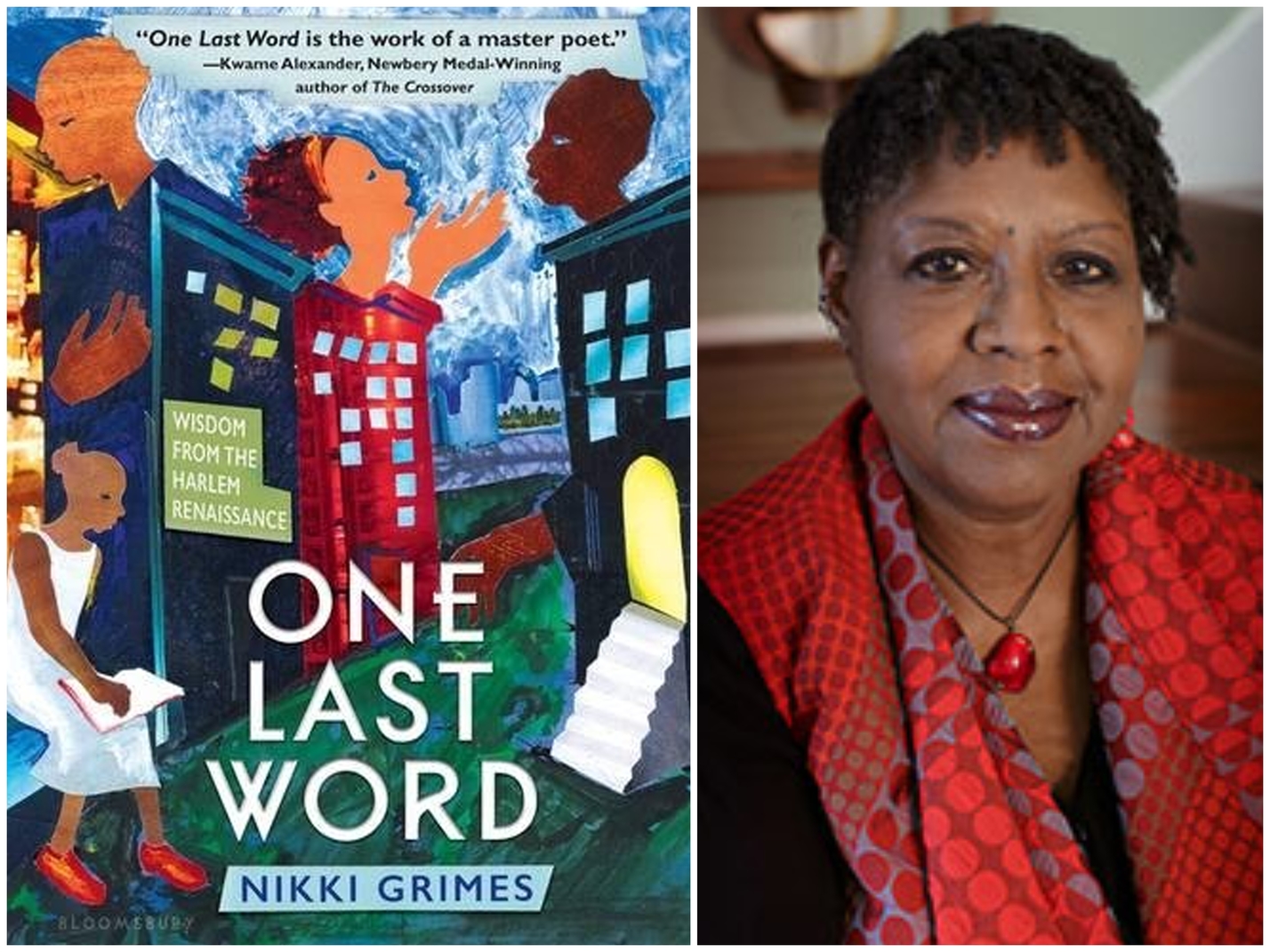
One Last Word cover; Nikki Grimes, photo by Aaron Lemen (from nikkigrimes.com)
The Harlem Renaissance was a deep-water era from which countless artists have since drawn inspiration.So too, Nikki Grimes whose latest collection, One Last Word: Wisdom from the Harlem Renaissance, includes poems not only from luminaries of that illustrious period, but also original poems by Grimes herself, who, via the Golden Shovel method, updates social issue of 1920s and �30s Harlem for a 21st century readership.Borrowing lines from Langston Hughes, Countee Cullen and a score of other Harlem Renaissance poets, and pairing her poems with vivid, evocative artwork, Grimes� collection is a fitting tribute to her cultural and literary forebears, while cementing her reputation as an adept children and young adults� (and adults�) poet.
Each of Grimes� original poems borrows words or lines, utilizing a form called Golden Shovel, to incorporate into her own work.�The idea of the Golden Shovel poem,� writes Grimes, �is to take a short poem in its entirety, or a line from that poem (called a striking line), and create a new poem, using the words from the original.Say you decide to use a single line: you would arrange that line, word by word, in the right margin.�The next step is writing �a new poem, each line ending in one of these words� (6).The first stanza of Arna Bontemps� poem �Southern Mansion,� for example, reads:
Poplars are standing there still as death
And ghosts of dead men
Meet their ladies walking
Two by two beneath the shade
And standing on the marble steps.
An original poem based upon the final lines of each poem might be:
I drink deep to their life and to their death�
those who came before me, those raggedy men
who spent their burdenful time on earth trudging,
seeking their hour in the undemanding shade.
Ever searching, forever counting their steps.
Utilizing the last word of each line in a stanza, however, is but one way the Golden Shovel can work.Each word in a single line can also serve the same purpose, as in the case of Georgia Douglas Johnson�s �Calling Dreams,� and Grimes answer, �The Sculptor."Johnson writes:
The right to make my dreams come true I ask, nay, I demand of life, Nor shall fate�s deadly contraband Impede my steps, nor countermand.
Too long my heart against the ground
has beat the dusty years around,
And now, at length, I rise, I wake!
And stride into the morning-break! (31)
Taking Johnson�s concept a step further, Grimes offers a more specific version of a similar theme.Grimes writes:
No accident of birth or race or even place determines the
scope of hope or dreams I have a right to.I inventory my head and heart to
weigh and measure what talents I might use to make
my own tomorrow.It all depends on the grit at my
disposal.My father says hard work is the clay dreams
are molded from.Yes.Molded.Dreams do not come.
They are carved, muscled into something solid, something true. (32)
But adaptability of form�which words, lines or even stanzas to borrow�is only half the story.A poet indulging in Golden Shovel is also at liberty, as in the case of the collection�s first pairing, Jean Toomer�s �Storm Ending,� with Grimes� original poem �Truth,� to make their own thematically unique work. Toomer writes:
The human presence in Toomer�s poem intrudes upon the imagery very little.One could possibly read metaphor into the poems subject matter, especially given the themes found in many of Toomer�s other works, but the poem demands no such leap.�Storm Ending� can be taken at face value.In Grimes� Toomer-inspired poem, however, the human presence is nearly everything.Toomer�s meteorology becomes Grimes� metaphor for outlining the human condition.Grimes writes:
The truth is, every day we rise is like thunder�
A clap of surprise.Could be echoes of trouble, or blossoms
of blessings.You need know what garish or gorgeously
disguised memories-to-be might rain down from above.
So, look up!Claim that cloud with the silver lining.Our
job, if you ask me, is to follow it.See where it heads. (16)
The adaptability of both form and theme is part of what makes the golden shovel so attractive.Thematic differentiation serves throughout the book as a reminder that Grimes does not work for but with the inspirational poems she has selected.Which is often the whole point.The golden shovel is not only a way of honoring, but simultaneously a springing forth from other�s works.This duality, of course, is what One Last Word is all about. Grimes never fails to honor, but she refuses to be confined.
Grimes is a self-professed poet for children and young adults.Her youthful audience is catered too tastefully throughout the book.From the simplistic descriptions that preface the collection�an overview of the Harlem Renaissance, definition of golden shovel, and poets� biography�to the vivid imagery of young people appearing throughout the book.
Artwork by E.B. Lewis
Artwork by Frank Morrison
Artwork by Shadrack Strickland
The poems, too, often feature young people; in Grimes� �Crucible of Champions,� for example, each stanza begins the name of the stanza�s young speaker:
Jamar
The evening news never spares us.Tune in and we hear: if you�re a boy and you�re black, you live
with a target on your back.We each take it in and shiver, one sharp-bladed question hanging overhead: how
long do I get to walk this earth?The smell of death is too intense,
and so we bury the thought, because the future is
ours, right?We get to choose?Well, we choose life.
Dina
Stupid is the word that stalks me.I�m anything but, so
I seethe inside.Even on a good day, I�m full of an anger that burns my breath.Who?It�s all because of my diagnosed dyslexia.Ask me to read aloud, I stress.
Whenever the teacher calls on me in class, I stutter.So
most folks surmise that my head is hollow.Actually, it�s quite full.
My words and letters simply switch places.They�ve got a mind of
their own.I call that reason enough for stress, for strife. (lines 1-17)
Given the personas represented in the six stanzas, it�s perhaps fitting �Crucible of Champions� would be considered a poem for juveniles.This assessment, of course, doesn't tell the whole tale.Educators, parents, and in fact any adult who wants to better understand the life of a young person, especially a young person of color, has a great deal to learn from the six people represented therein.That said, when Grimes herself claims that, though she began her career focusing on the adult market before shifting her �emphasis to literature for children and young adults� (page 1), the claim certainly has credence, but no reader should underestimate her work because it bears the label. The distance between juvenile and adult poetry is not so great as we might think.
Grimes speaks at the
2017 Newbery-Caldecott-Wilder Banquet
________________________________________________
AN [EMAIL] INTERVIEW WITH NIKKI GRIMES
Anthony Fife: In the preface, you say that the poets of the Harlem Renaissance were among your earliest influences.Geographically, at least, that makes a lot of sense; you are, after all, from Harlem.But what about the work itself, regardless of geography, was so appealing to you as a child?
Nikki Grimes: I came to this work in my teens, during the early 60s, at the flashpoint of the Civil Rights Movement, the rise of the Panther Party, and the new slogan of Black Power.The poets of the Harlem Renaissance were addressing the very issues of racial and social injustice that we were wrestling with, at that time.Paul Laurence Dunbar's "We Wear the Mask" spoke to me.Countee Cullen's "Incident" was my own story.Waring Cuney's "No Images" and Langston's "Harlem Sweeties" ("Carmel, brown sugar/A chocolate treat") let me know I was comely even before the phrase "Black is Beautiful" was coined.Cullen's "Yet Do I Marvel" was the "Yes!" to my personal drive to write poetry in spite of the emotional wreck and dysfunction of my family life.
"Inscrutable His ways are, and immune...
What awful brain compels His awful hand;
Yet do I marvel at this curious thing:
To make a poet black, and bid him sing!"
I was that poet!
I still read Langston, of course, and I love to return to Georgia Douglas Johnson and Gwendolyn Bennett.And the language of Jean Toomer still plucks the strings of my heart.
AF: How long after learning the Golden Shovel form did it take you to conceive of this project?
NG: I had two ideas for projects immediately after writing my first Golden Shovel poem.I knew I wanted to do something with poetry of the Harlem Renaissance, specifically bringing it to an audience of young readers who might not otherwise appreciate its relevance.And I wanted to introduce readers to some of the female poets of the period they probably weren't familiar with.The other idea I had was to apply the form to an exploration of the Psalms.The Harlem Renaissance project ended up being idea I attacked first.
AF: Is the golden shovel a form that, aside from One Last Word, you often use?
NG: This form is relatively new, so I haven't had many opportunities to use it, yet, but I have written a picture book using this form.It's called TheWatcher, and it grew from the lines of Psalm 121, one of my favorites.
AF: What other forms are common or important in your work?
NG: I love free verse, haiku, and tanka. These are forms I return to often. But I'm addicted to challenge, and so I'm looking to explore other forms, as well.Each form of poetry takes me places I wouldn't go, otherwise.
AF: What are some of the challenges of golden shovel poems that differentiate it from challenges of other forms?
NG: While other forms lock the poet in where meter is concerned, Golden Shovel forces you to use words that may or may not fit comfortably in your mouth, or in your psyche.If, for instance, you select your striking line from a poem written during another period in time, you may end up having to wrestle with language that is antiquated, or be stuck having to use a word that you would never encounter in current speech.In one of the Renaissance poems I chose, a striking line included the word "Chromatique."That was quite the head scratcher!What on earth, I kept asking myself, am I supposed to do with that word????I ended up using it as the name of a hair salon.
The other aspect of the Golden Shovel that's challenging is determining what your poem is going to be about, and then working out a strategy for using the words you've chosen to help tell that story.For me, it feels a bit like sculpture in that I don't know what I'm going to end up with until I get there.I just take my raw material�words�and keep chipping away until something coherent begins to emerge.
AF: I notice that many of your original poems in this collection are persona poems.How does adopting the perspective of another, be they real or fictional, help shape the trajectory of your poems?
NG: I'm a character-driven writer, and delving into character is most often my way into story, whether that takes the form of a prose work, a novel-in-verse, or a narrative poem.So character was also my default, here.When I asked myself, with each striking line I chose, "Now what is this poem going to be about? What story will I tell?" I turned to characters to suss it out.Once I climb into a character's skin and look at the world, or a given situation, through his or her eyes, my direction becomes very clear.
AF: Indeed, several of your poems adopt a different persona from stanza to stanza.These are among my favorites in the book.Could you speak to the interplay of the one character to another to another aspect of these poems?
NG: There is something about the dance between two or more characters that add energy and a certain dynamic to the narrative that I love.When I was developing as a young artist, I spent time in the theater, and I brought that sensibility into my writing.I'm forever picking up snatches of dialogue between strangers, and imaging interplay between characters long before they make it to the page.I can't help it.I love placing a number of characters in a space and then seeing how they interact how they impact or influence one another.I suppose that's why I keep writing multi-voiced novels like Bronx Masquerade, a novel in prose and poetry written in 18 voices.It's a kind of sickness, I suppose, but it's all mine!
AF: In part because of the multiple personae in some of your poems, your work, on average, tends to be much longer than that of your literary ancestors.Whereas many of the Harlem Renaissance poems you exemplify in this collection are relatively brief (usually fitting comfortably on one page) yours is much more expansive.Could you please talk about that?
NG: Well, by virtue of the form I've chosen, every word of every line I select from the original poem becomes a new line.On that basis alone, the minute I select more than a single line, the resulting poem is bound to be longer than the original, even more so in those cases where I've chosen to use the lines of an entire stanza.Then, of course, in the few cases where I used the words of an entire longer poem, well the growth is exponential.That's one answer.
Beyond the above, I was seeking to expand the subject matter both to express the intent of the original poem more clearly for young readers, and to bridge the gap between their own point in time, and the period of the Harlem Renaissance poets.I want to make sure readers fully appreciate the relevance of the Renaissance poetry today.Sometimes, that requires a bit of expansion.
AF: Did you have a relationship with any of the artist beforehand or were they and their work kind of brought to you by the publisher or something like that?
NG: More and more books for middle grade readers are being illustrated, these days, and so I knew there would be some art, though precisely what form it would take was an unknown.When the text was complete, my publisher suggested that, rather than having a single artist illustrate the book, we might, instead, invite a variety of artists to do one illustration per poem.I thought that was a brilliant idea, and immediately agreed.I compiled a list of artists for the publisher to contact, and we went from there.Most of the artists have illustrated one or more of my picture books, over the years, or else illustrated my poems in various anthologies, so I was familiar with their work, and their artistic sensibilities.And, of course, I relished the opportunity to do one of the illustrations, myself�a first for me!
AF: As the final question I always mention the title of the blog: Poetry Matters.Of course, it can be read as "stuff about poetry," but it can also be read as the bold declaration "poetry DOES matter!"Taking the latter as our guide, please explain to me why poetry DOES, in fact, matter.
NG: There are so many experiences in life for which language, in general, is ill-suited: the birth of a child, the death of a loved one, the upheaval caused my natural, or unnatural, disasters.Things that cannot be articulated otherwise can always find expression in poetry.We humans have so much pent-up stress and anxiety�particularly in this present age�that we desperately need a healthy mental and emotional outlet. Poetry offers that.Poetry is a celebration of language, of beauty, of truth�all that we need for the health of our souls.The world would be demonstrably poorer without poetry.Who would choose to live in such a world?Not I. ________________________________________________
New York Times bestselling author Nikki Grimes is the recipient of the 2017 Laura Ingalls Wilder Medal, the 2016 Virginia Hamilton Literary Award, and the 2006 NCTE Award for Excellence in Poetry for Children. Her distinguished works include the much-honored books Garvey's Choice, ALA Notable book What is Goodbye?, Coretta Scott King Award winner Bronx Masquerade, and Coretta Scott King Author Honor books Jazmin's Notebook, Talkin' About Bessie, Dark Sons, Words with Wings, and The Road to Paris. Creator of the popular Meet Danitra Brown, Ms. Grimes lives in Corona, California.
Visit the official Nikki Grimes website: http://www.nikkigrimes.com/
To purchase your own copy of Nikki Grimes� One Last Word: Wisdom from the Harlem Renaissance, visit Bloomsbury publishers at: https://www.bloomsbury.com/us/one-last-word-9781619635548/
Alice is sitting with her sister outdoors when she spies a White Rabbit with a pocket watch. Fascinated by the sight, she follows the rabbit down the hole. She falls for a long time, and finds herself in a long hallway full of doors. There is also a key on the table, which unlocks a tiny door; through this door, she spies a beautiful garden. She longs to get there, but the door is too small. Soon, she finds a drink with a note that asks her to drink it. There is later a cake with a note that tells her to eat; Alice uses both, but she cannot seem to get a handle on things, and is always either too large to get through the door or too small to reach the key. While she is tiny, she slips and falls into a pool of water. She realizes that this little sea is made of tears she cried while a giant. She swims to shore with a number of animals, most notably a sensitive mouse, but manages to offend everyone by talking about her cat's ability to catch birds and mice. Left alone, she goes on through the wood and runs into the White Rabbit. He mistakes her for his maid and sends her to fetch some things from his house. While in the White Rabbit's home, she drinks another potion and becomes too huge to get out through the door. She eventually finds a little cake which, when eaten, makes her small again. In the wood again, she comes across a Caterpillar sitting on a mushroom. He gives her some valuable advice, as well as a valuable tool: the two sides of the mushroom, which can make Alice grow larger and smaller as she wishes. The first time she uses them, she stretches her body out tremendously. While stretched out, she pokes her head into the branches of a tree and meets a Pigeon. The Pigeon is convinced that Alice is a serpent, and though Alice tries to reason with her the Pigeon tells her to be off.
Alice gets herself down to normal proportions and continues her trek through the woods. In a clearing she comes across a little house and shrinks herself down enough to get inside. It is the house of the Duchess; the Duchess and the Cook are battling fiercely, and they seem unconcerned about the safety of the baby that the Duchess is nursing. Alice takes the baby with her, but the child turns into a pig and trots off into the woods. Alice next meets the Cheshire cat (who was sitting in the Duchess's house, but said nothing). The Cheshire cat helps her to find her way through the woods, but he warns her that everyone she meets will be mad. Alice goes to the March Hare's house, where she is treated to a Mad Tea Party. Present are the March Hare, the Hatter, and the Dormouse. Ever since Time stopped working for the Hatter, it has always been six o'clock; it is therefore always teatime. The creatures of the Mad Tea Party are some of the must argumentative in all of Wonderland. Alice leaves them and finds a tree with a door in it: when she looks through the door, she spies the door-lined hallway from the beginning of her adventures. This time, she is prepared, and she manages to get to the lovely garden that she saw earlier. She walks on through, and finds herself in the garden of the Queen of Hearts. There, three gardeners (with bodies shaped like playing cards) are painting the roses red. If the Queen finds out that they planted white roses, she'll have them beheaded. The Queen herself soon arrives, and she does order their execution; Alice helps to hide them in a large flowerpot. The Queen invites Alice to play croquet, which is a very difficult game in Wonderland, as the balls and mallets are live animals. The game is interrupted by the appearance of the Cheshire cat, whom the King of Hearts immediately dislikes. The Queen takes Alice to the Gryphon, who in turn takes Alice to the Mock Turtle. The Gryphon and the Mock Turtle tell Alice bizarre stories about their school under the sea. The Mock Turtles sings a melancholy song about turtle soup, and soon afterward the Gryphon drags Alice off to see the trial of the Knave of Hearts. The Knave of Hearts has been accused of stealing the tarts of the Queen of Hearts, but the evidence against him is very bad. Alice is appalled by the ridiculous proceedings. She also begins to grow larger. She is soon called to the witness stand; by this time she has grown to giant size. She refuses to be intimidated by the bad logic of the court and the bluster of the King and Queen of Hearts. Suddenly, the cards all rise up and attack her, at which point she wakes up. Her adventures in Wonderland have all been a fantastic dream.
The story begins in a meadow of 19th century England, where the young horse, Black Beauty, has just been born. There, his mother nurtures him, raises him and gives him advice which he remembers and acts on for the rest of his life: do good and give your best effort always and everything will work out. The story of his life is this advice in living form. As his youngest days pass in that meadow, he witnesses the death of his own brother and a rider in a hunting accident. Soon after, he must undergo the breaking-in process where his trainer gently teaches him to bear a rider, wear a saddle and bridle and respond to the rider’s driving signals. After this coming-of-age training, he is ready to leave the meadow of his youth. He is sold to Squire Gordon, a man who takes a liking to this strong, young, beautifully dark coated horse. Squire Gordon’s residence, Birtwick Park, thus becomes Beauty’s new home. There he meets those who will become among his dearest friends: Ginger, Merrylegs, John Manly and James. John is his new coachman, and a good, wise, gentle old fellow. James and Joe, his two successive grooms, were also quite caring and well-intentioned. So he soon falls in love with his new home and is happy there, except for one problem: he misses his liberty. Never again is he left to do just as he wishes; instead, he will be ordered and ridden by this human or that human without break. The earliest days of his youth are over and he can no longer roam around meadows and spend his days resting with his mother anymore. Despite this loss of liberty, Beauty is still happy to be in this situation rather than a situation where the owner was cruel or neglectful, and soon enough he becomes accustomed to the life-long burden of servitude towards humans. One day when in conversation with his friends Ginger and Merrylegs, he hears stories of wicked masters. The former horse, a powerful, lively mare, tells of her harsh upbringing and how it scarred her for life to have a neglectful master. Thus the horses of Birtwick begin their long discussion amongst themselves concerning the faults in humans rule over horses and the cruelties horses often face.
Together, the horses point out some of the many flaws in the relationship between man and horse. Sir Oliver—an aged horse on Birtwick whose tail his masters cut off--argues that man mutilates the animals within their care in the name of fashion or looking sharp. So they cut tails off or they slice ears for aesthetic purposes. Doing this, he says, they cause a lot of pain and they also interfere with God’s creation, for the body parts that they cut off tend to have some function which they overlooked (like the horse’s tail functioning as a fly-swatter). The blinkers which drivers force horses to wear are similarly misguided: they prevent the horse from seeing and thus interfere with the way God created horses, as the horses point out. Humans should just leave their animals as they were meant to be and not attempt to change that.
As time passes, Black Beauty becomes a more trusted member of the estate. This is mostly due to the fact that one day, Beauty trusted his intuition in an emergency situation and saved the life of his master and driver. So he became a loved member of the hall, especially for John and James Howard his groom. Soon though, James receives word that a friend of Squire Gordon’s is looking for a skilled groom to work for him; the pay and prospect is considerable so with Gordon’s recommendation and John’s advice, James moves on to this new job, but not before another adventure with Beauty where James saves horses from a burning barn, further earning the praise and commendation of Squire Gordon. Joe Green is his replacement, a young, gentle fellow who does not know much about grooming but is eager to learn. One day, Beauty and John dash to a distant town to find a doctor that can come treat the Squire’s wife, who has taken ill. Beauty performs splendidly and it is likely that his speed in going and coming saves the lady’s life. However, in the aftermath of that he becomes ill when the well-intentioned Joe is unable to care for the exhausted horse properly. John becomes furious and when Joe’s father attempts to defend his son by saying it was just the boy’s ignorance and he meant no harm, John utters one of the key themes of the book: ignorance is as harmful as cruelty, despite whatever intentions the person has. But John eventually calms down, forgives Joe and becomes his mentor. Joe learns quickly and—after a touching experience of standing up for oppressed horses—he matures quite rapidly. Life continues happily until the Squire’s wife becomes ill again and the doctor advises them to leave the country for a healthier clime. Squire Gordon and his family thus leave and sell Merrylegs to one buyer and Ginger and Black Beauty to another buyer, the Earl of W, Beauty’s life in Earlshall, while not terrible, is nothing like Birtwick. At this hall his master’s wife demands that all her horses wear the check rein, a device which forcibly holds up the horse’s head, causing it lasting pain and undercutting its pulling strength. She forces the coachman—Mr. York—to put check reins on both Ginger and Beauty. Ginger eventually rebels against this measure and attempts to kick free but is subdued by the grooms. So the two horses become accustomed to this discomfort. When the family temporarily leaves the hall along with Mr. York, Reuben Smith becomes the temporary caretaker of the horses. This man is highly skilled and knowledgeable about taking care of horses, Beauty notes, yet he has one fatal flaw: he has a drinking problem. This issue changes the course of his life and Beauty’s when one day, riding back towards the hall in a drunken state, Smith fails to properly maintain Beauty’s shoes. This results in Beauty’s legs collapsing part-way through the journey, throwing Smith off and killing him. Beauty himself has to undergo a painful medical procedure which leaves his legs permanently scarred. The Earl decides he cannot keep a horse in such a scarred state so he sells Beauty; Beauty goes through a number of buyers until he ends up a job horse to be rented out by drivers. Here for the first time he encounters bad drivers, and, because these drivers often do not know how to properly drive or take care of horses, he receives long-term physical harm. Eventually though a gentleman who takes pity on Beauty convinces his friend to buy the horse and so Beauty becomes the property of Mr. Barry. This fellow, while a good man who orders that the horse be treated well, fails in his selection of caretakers for the horse. Twice he hires grooms who, when Mr. Barry is not watching, behave in ways which further hurt the horse. Mr. Filcher—the first of the two—steals food meant for Beauty and uses it for his own commercial purposes. Alfred Smirk—his replacement—acts as if he knows how to take care of horses but in reality leaves Beauty’s stall in such terrible conditions that the horse becomes ill. After uncovering this second deceptive groom, Mr. Barry decides not to keep the horse at all and instead sends Beauty to be sold at a horse fair.
At the horse fair, Beauty comes dangerously close to becoming the property of a mean, cruel-looking man; but in the end, a kind and empathetic man buys him. This man is Jeremiah Baker—though he goes by Jerry. He works as a cab driver in London and though he does not make much money, he makes enough to feed his wife and son and daughter and to take good care of the horses. Jerry and Beauty take a strong liking to each other right away, and soon Beauty comes to the conclusion that Jerry is the best man he ever knew. Always gentle, cheerful and adept, he helps Beauty adapt to the otherwise disheartening life of a London cab horse. The two, along with Jerry’s other horse—Captain, an old, dignified warhorse—have several adventures together. On one occasion a woman approaches Jerry asking for directions to the hospital to get medical help for her child. He insists on driving her there himself free of charge, and this act of kindness immediately brings returns to Jerry: as soon as he drops her off, he picks up another customer, this time his wife’s old mistress, who offers to find Jerry a less strenuous job and gives him a gift of ten shillings. On another occasion, Jerry—who normally never works on a Sunday as he is a religious man who preserves the Sabbath—agrees to take a woman on Sunday to her dangerously-ill mother outside the city. This act too immediately pays off for Jerry, as he and Beauty—while waiting to bring back the lady--enjoy the beautiful meadow next to the mother’s house in the countryside. This happy part of Beauty’s life, too, comes to an end. In the third winter they are together, Jerry becomes severely ill, nearly dying. His doctor tells him not to go back to the cab business, so he decides to look into the old mistress’s employment offer. With great delight, the family soon receives the news that they will indeed work for this lady, and that they will be living in the country in a nice cottage and Jerry will there be a coachman and receive a comfortable salary. This delight is bittersweet, as it means leaving behind their beloved horse Jack—their name for Black Beauty—and their departing is just as bittersweet for the horse as well since he is happy for their prosperity but sad to leave them and apprehensive about his own future state.
After making a thorough search for a buyer who would be kind to his horses, Jerry decides to sell Beauty to a friend of his who works in corn dealing. His stay there would have been quite pleasant, Beauty notes, had this principled corn dealer been on the premises to watch out for his horses. The problem though was that when he was not on the premises, the foreman would overload the horses in order to increase the productivity of the business. As the foreman continued, day after day, to overburden the loads of the horses, Black Beauty and the other horses began to physically wear out. Soon enough, Black Beauty becomes too weak to work much longer there, and his owner sells him to a cab business owner named Nicolas Skinner. This man employed cab drivers and rented out the horses to them on a daily basis. He was exploitative of these men and they in turn were exploitative of their horses, as they had to overwork the horses to make enough money to pay off the rental fees. At no point in Beauty’s life does he suffer more than at the hands of these harsh-handed men. He continues to try his best though until his health simply deteriorates. Skinner, having sucked out what benefit he could from the horse, sends him to a horse market. Much like the previous story of the horse market, another kind man takes a liking to Black Beauty and buys him. This time it is Farmer Thorough good, who buys the horse under the encouraging of his little grandson Willie and decides to nurture him back to health before selling him again. The farmer and his grandson take excellent care of Beauty, and the horse, having just come out of the hardest part of his life, begins to feel happiness again. Although Beauty is by now an old horse, he fully recovers and Thorough good takes him to potential buyers. These buyers are Miss Blome field and Miss Ellen, who live in a pleasant house in the countryside. They took a liking to the horse despite the scars on his legs from his old injury. Their groom also approves of the horse, and so they buy him from Thorough good. When the groom then begins to clean Beauty, he notices a few of the horse’s white marks on his otherwise black coat and he says to himself that this horse looks an awful lot like old Black Beauty. As he continues, the marks become unmistakable and he exclaims in joy that this must be Black Beauty and that he himself is Joe Green, Beauty’s old and dear friend from Birtwick. Joe is now a young man and Beauty an old horse, yet there old friendship immediately resurfaces. As it turns out, the ladies of the house are benevolent masters, Joe is an excellent groom and little Willie continues to visit his new friend Beauty frequently, so Beauty finds great happiness and peace in his new home. It is here that the story ends. Beauty is at peace, saying that often now, before he becomes fully awake, he feels like he is again under the trees of the orchard, standing contentedly with his old friends and talking with them.